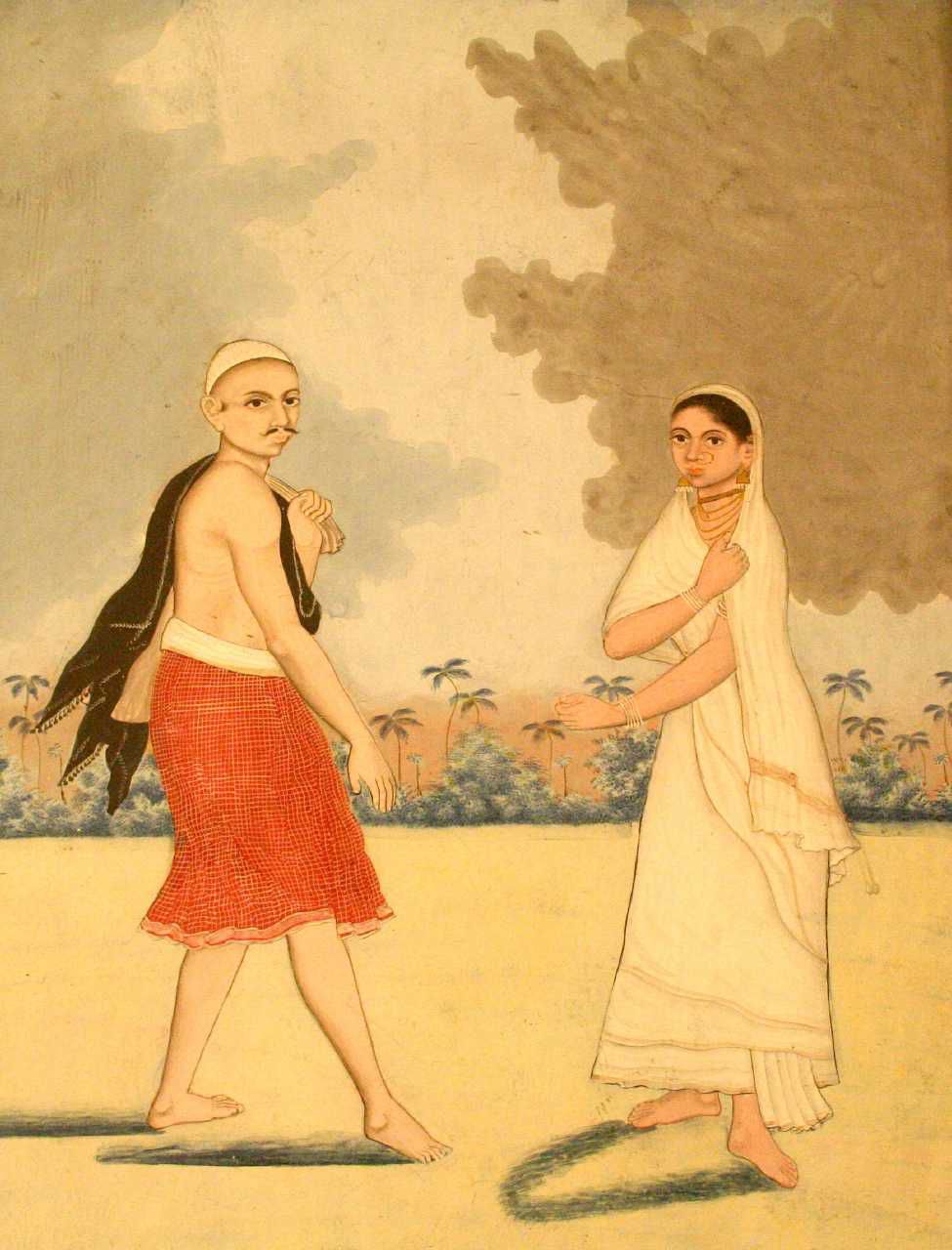
Company painting, ca. 1800
Download
Del
Beskrivelse
In the museum register the painting is named: “A Muslim who sells pearls and other related things at people’s doors, and his wife”, (translated from Danish: "En Mohrman som sælger perler og andre ting angående til folks døre og hans kone”). One of a series of Indian miniature paintings depicting a wide range of different occupations, trades and castes in the late eighteenth century. The paintings are in the style known as company paintings, a unique artistic tradition which artists at the royal court in Thanjavur played quite an impressive role in developing. The paintings portray local people, plants, birds, festivals and working scenes and were made to be bought as souvenirs by civil servants employed by the European trading companies. Particularly popular were series with motifs of different castes and occupations depicting typical tools and differences in costume. These paintings of everyday Indian life may of course be interpreted as a reflection of European attempts to understand the culturally complex Indian society through classification and categorisation. However, being naturalistic yet rather exotic depictions, they may also be seen as an expression of a desire in royal Indian patrons and artists to portray India in a manner comprehensible to the Western eye and present local folklife in an aesthetic way. This company paintings was collected by Reverend Niels Fuglsang who also furnished them with titles which here have been translated from Danish. Fuglsang served the Danish Lutheran congregation at the Zion Church in Tranquebar between 1792 and 1802. During his stay he collected around 150 artefacts such as religious items, handwritten scripts and around 70 company paintings. After his death in 1832 the collection was given to the Danish king in return for a yearly pension to Fuglsang’s daughters. Later the collections of scripts and other items were donated to the Royal Danish Library and to the Ethnographical Collection, now part of the National Museum of Denmark. The painting is gouache on paper, unknown artist, around 1800.
Tid
Datering
2005
Senest opdateret
Friday, October 13, 2023
Placering
Koordinater
11.02538, 79.8556
Emneord
Kommentarer
Detaljer
Fotograf
Laura Berivan Nilsson
Licens
Kilde
Nationalmuseet
Fil-ID
ES-330944
Filnavn
Muslimsk sælger.jpg
Original filstørrelse
1 MB
Original opløsning
1744x2291 pixels
OK
Kopiér link
Kopiér HTML-kode
Company painting, ca. 1800
In the museum register the painting is named: “A Muslim who sells pearls and other related things at people’s doors, and his wife”, (translated from Danish: "En Mohrman som sælger perler og andre ting angående til folks døre og hans kone”). One of a series of Indian miniature paintings depicting a wide range of different occupations, trades and castes in the late eighteenth century. The paintings are in the style known as company paintings, a unique artistic tradition which artists at the royal court in Thanjavur played quite an impressive role in developing. The paintings portray local people, plants, birds, festivals and working scenes and were made to be bought as souvenirs by civil servants employed by the European trading companies. Particularly popular were series with motifs of different castes and occupations depicting typical tools and differences in costume. These paintings of everyday Indian life may of course be interpreted as a reflection of European attempts to understand the culturally complex Indian society through classification and categorisation. However, being naturalistic yet rather exotic depictions, they may also be seen as an expression of a desire in royal Indian patrons and artists to portray India in a manner comprehensible to the Western eye and present local folklife in an aesthetic way. This company paintings was collected by Reverend Niels Fuglsang who also furnished them with titles which here have been translated from Danish. Fuglsang served the Danish Lutheran congregation at the Zion Church in Tranquebar between 1792 and 1802. During his stay he collected around 150 artefacts such as religious items, handwritten scripts and around 70 company paintings. After his death in 1832 the collection was given to the Danish king in return for a yearly pension to Fuglsang’s daughters. Later the collections of scripts and other items were donated to the Royal Danish Library and to the Ethnographical Collection, now part of the National Museum of Denmark. The painting is gouache on paper, unknown artist, around 1800.