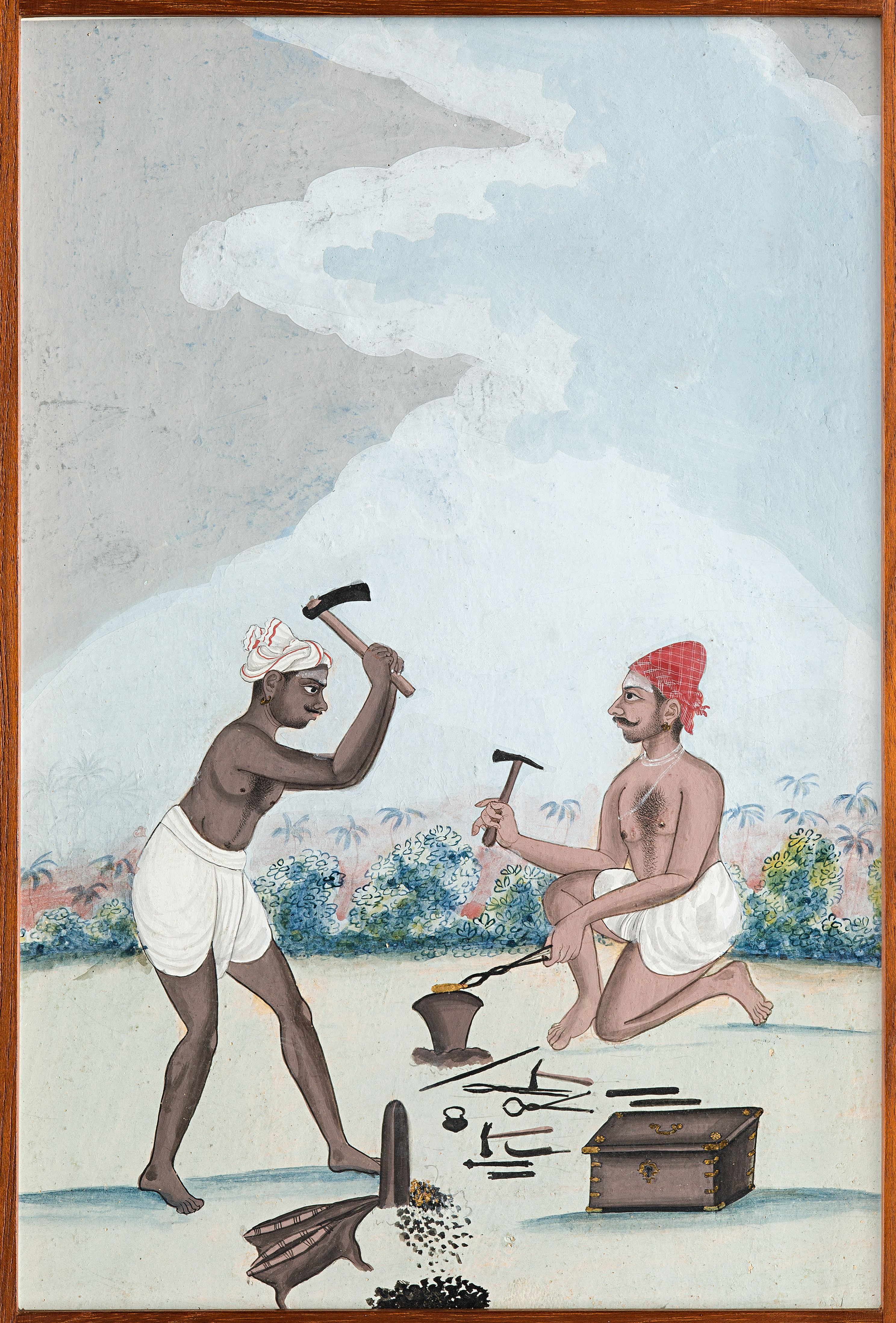
Blacksmiths, ca. 1800
Blacksmiths working. The desire to categorise and understand is figuratively presented in the large number of company paintings that Europeans either sent back or brought home with them from India in colonial times. These paintings often consist of sets of pictures presenting different types—castes, job positions, etc.—thus helping Europeans to define the Indians, and for friends and family members to be able to better envision an India that they did not know. Company paintings brought home by the Reverend Niels Fuglsang, who served the Danish Lutheran congregation at the Zion Church in Tranquebar between 1792 and 1802.
One of a series of Indian miniature paintings depicting a wide range of different occupations, trades and castes in the late eighteenth century. The paintings are in the style known as company paintings, a unique artistic tradition which artists at the royal court in Thanjavur played quite an impressive role in developing. The paintings portray local people, plants, birds, festivals and working scenes and were made to be bought as souvenirs by civil servants employed by the European trading companies. Particularly popular were series with motifs of different castes and occupations depicting husband and wife together with an emphasis on typical tools and differences in costume. These paintings of everyday Indian life may of course be interpreted as a reflection of European attempts to understand the culturally complex Indian society through classification and categorisation. However, being naturalistic yet rather exotic depictions, they may also be seen as an expression of a desire in royal Indian patrons and artists to portray India in a manner comprehensible to the Western eye and present local folklife in an aesthetic way.