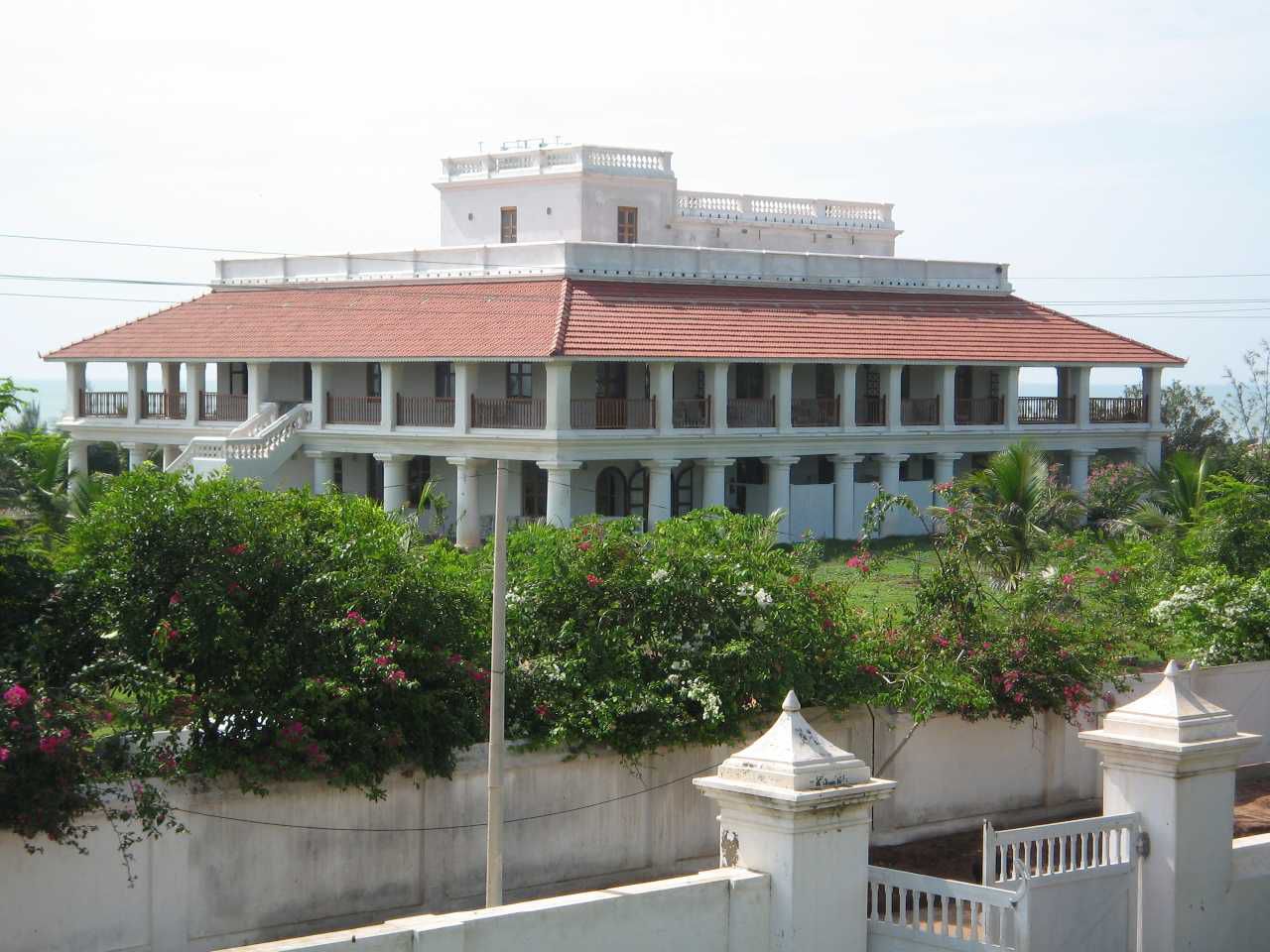
Den engelske collectors hus - nu hotel Bungalow on the Beach, 2007
Download
Del
Beskrivelse
The hotel is established in a historical building. In modern Tranquebar, the house was known locally until the 2000s as the “Nadar House”. The exact date of original construction of the building is unknown, but it is estimated that the building is from about 1830. It is constructed with three wings and later a fourth was added to the north towards the garden. Facing the Parade Ground, it was constructed with a protruding central part of the veranda. The height of the building was divided into a lower floor for storing goods and an upper floor for living where the wind could bring a cooling breeze from the sea. Records state that Arabella Mathilda Wright, married in the Zion Church on 7 February 1821 to Danish civil officer Wilhelm Petersen, inherited the building in December 1857 after the demise of her husband. After ten years, she sold the building to Thiru Vellia Nadar, from a prominent distillery family. His descendants maintained the building for 125 years first by renting it to the British Raj, who used it as judge’s house and collector’s residence. In the early 1990s, the house was sold by the Nadar family to the Taj group of hotels. Soon after, the house was taken over by the Neemrana Group of hotels. The sale happened in 2002 and the restoration process began in January 2003. The eight-room heritage hotel, named “Bungalow on the Beach”, was to be opened at the end of 2004 but for the Indian Ocean Tsunami that left the building with some damage. After the repair work was completed, the hotel finally opened three months later. Tranquebar – or Tharangampadi – is a village on the Coromandel Coast of south India. A large part of the population in Tranquebar are fishers or working within business related to fishing. The language is Tamil and the majority of the inhabitants adhere to religious traditions of Hinduism, but there are also smaller communities relating to Christianity or Islam. During India’s colonial period, Tranquebar functioned as a Danish trade station from 1620-1845. The place has a rich intercultural history, documented in historical buildings and rich archival sources as well as old and new ethnographic collections of material items, photos and accounts of everyday life.
Tid
Datering
2007
Senest opdateret
Friday, October 13, 2023
Placering
Koordinater
11.02538, 79.8556
Emneord
Kommentarer
Detaljer
Fotograf
Helle Jørgensen
Kilde
Nationalmuseet
Fil-ID
ES-315979
Filnavn
Efter_briterne_fig1.jpg
Original filstørrelse
3 MB
Original opløsning
2592x1944 pixels
OK
Down­load JPEG
2592x1944 pixels - Licens: CC-BY-NC-SA
Down­load original (JPEG Image)
2592x1944 pixels - Licens: CC-BY-NC-SA - 3 MB
Kopiér link
Kopiér HTML-kode
Den engelske collectors hus - nu hotel Bungalow on the Beach, 2007
The hotel is established in a historical building. In modern Tranquebar, the house was known locally until the 2000s as the “Nadar House”. The exact date of original construction of the building is unknown, but it is estimated that the building is from about 1830. It is constructed with three wings and later a fourth was added to the north towards the garden. Facing the Parade Ground, it was constructed with a protruding central part of the veranda. The height of the building was divided into a lower floor for storing goods and an upper floor for living where the wind could bring a cooling breeze from the sea. Records state that Arabella Mathilda Wright, married in the Zion Church on 7 February 1821 to Danish civil officer Wilhelm Petersen, inherited the building in December 1857 after the demise of her husband. After ten years, she sold the building to Thiru Vellia Nadar, from a prominent distillery family. His descendants maintained the building for 125 years first by renting it to the British Raj, who used it as judge’s house and collector’s residence. In the early 1990s, the house was sold by the Nadar family to the Taj group of hotels. Soon after, the house was taken over by the Neemrana Group of hotels. The sale happened in 2002 and the restoration process began in January 2003. The eight-room heritage hotel, named “Bungalow on the Beach”, was to be opened at the end of 2004 but for the Indian Ocean Tsunami that left the building with some damage. After the repair work was completed, the hotel finally opened three months later. Tranquebar – or Tharangampadi – is a village on the Coromandel Coast of south India. A large part of the population in Tranquebar are fishers or working within business related to fishing. The language is Tamil and the majority of the inhabitants adhere to religious traditions of Hinduism, but there are also smaller communities relating to Christianity or Islam. During India’s colonial period, Tranquebar functioned as a Danish trade station from 1620-1845. The place has a rich intercultural history, documented in historical buildings and rich archival sources as well as old and new ethnographic collections of material items, photos and accounts of everyday life.